
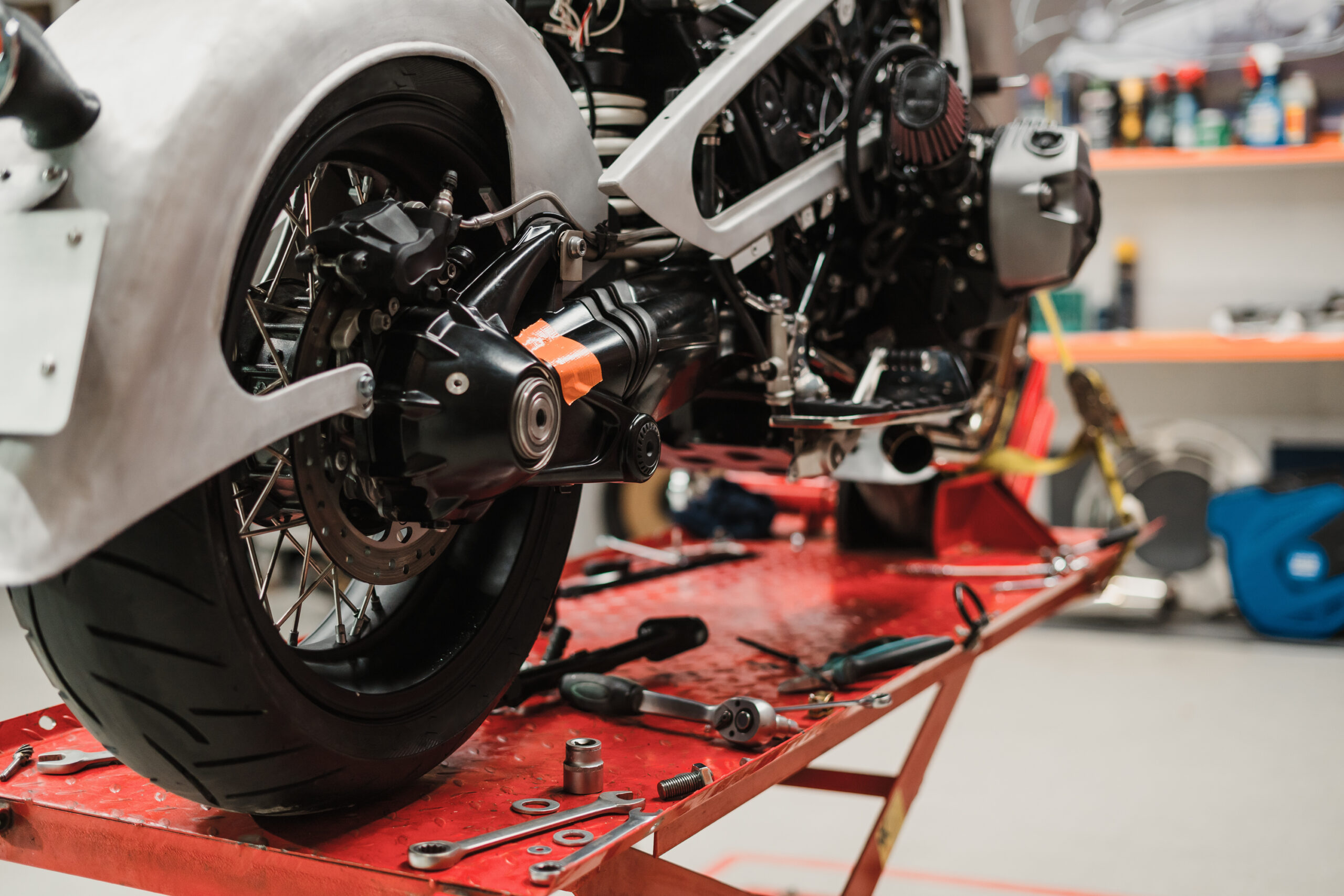
If you work on your motorcycle often, you’ve probably hit the point where crouching on the floor or reaching under the frame for hours just isn’t cutting it anymore. The best motorcycle lift brings the bike up where you can actually see what you’re doing and gives you proper support for more complicated jobs.
The hard part is figuring out which lift will reliably hold your bike the way you need it to. Choosing the wrong style can leave you with limited lift height or a setup that doesn’t feel stable once the bike’s in the air.
Finding a lift that fits your setup can feel overwhelming, especially with so many styles and capacities to compare. This guide breaks down the most reliable options so you can choose the motorcycle lift that works best for the way you like to maintain your bike.
Best motorcycle lifts
There are a lot of motorcycle lifts out there, all built for different bike weights, shop spaces, and types of maintenance. Let’s look at the best options so you can find a lift that fits the way you work.
- Ranger RML-1100

The Ranger RML-1100 is a low-rise jack built for full wheel service on motorcycles and ATVs. You can use it directly on the floor or pair it with a lift platform, depending on how much working room you need. The two adjustable saddle adapters help stabilize different frame styles, which comes in handy if you work on custom bikes or anything that doesn’t sit flat on a standard jack.
The 16″ max height gives you extra clearance for wheel removal, brake work, and routine maintenance. The lift is also supported by Ranger’s technical support, so if you ever run into a setup or maintenance question, you can get help.
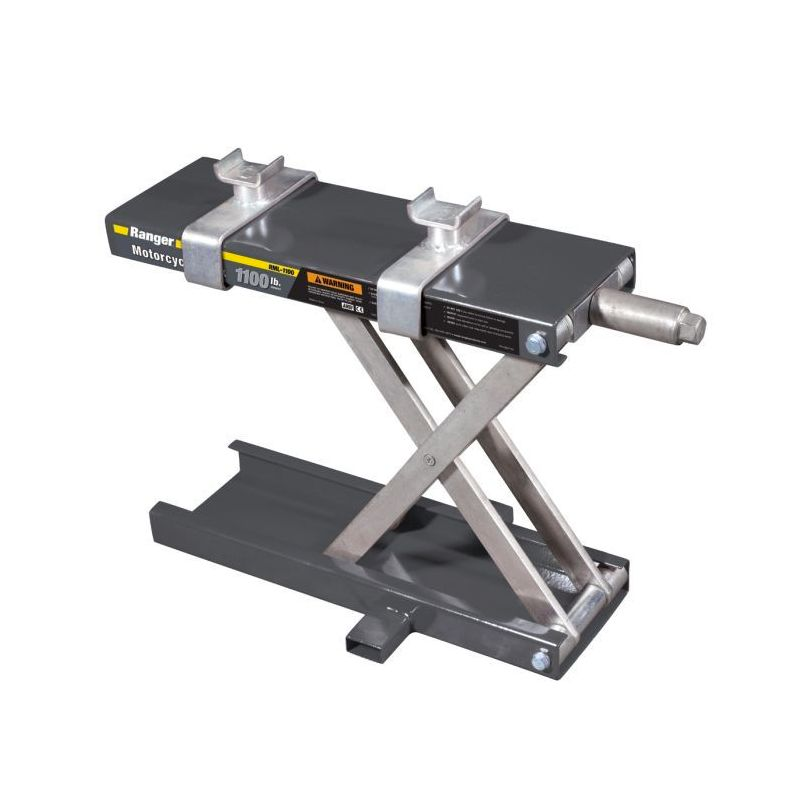
Features:
- 1,100 lbs. weight capacity
- 3.5″ to 16″ lift range
- 6″ × 17.75″ top platform dimensions
- Low-rise mechanical jack
- Adjustable saddle adapters included
- 30 lbs. shipping weight
- 14″ × 21″ × 4″ shipping dimensions
- Ranger-backed warranty
Pros:
- Works alone or with a lift platform depending on your setup
- Low profile fits under custom bikes that sit too low for standard jacks
- Adjustable saddle adapters help stabilize uneven or modified frames
- Solid working height for wheel service and general maintenance
Cons:
- 16″ max height doesn’t replace a full-size lift table
Learn more about the Ranger RML-1100.
- Ranger RML-1500XL

The Ranger RML-1500XL is a high-capacity motorcycle lift built for riders and shops that need a full-size platform with reliable stability. It uses 12-gauge steel, a stretched tabletop, and a tall lifting height to handle almost any motorcycle, chopper, or ATV in its weight class. The platform includes a front wheel vise, removable side decks, automatic safety locks, retractable casters, and a drop-down rear deck for wheel and suspension work. Ranger backs the lift with ongoing technical support, which helps if you ever need guidance on setup or long-term use.
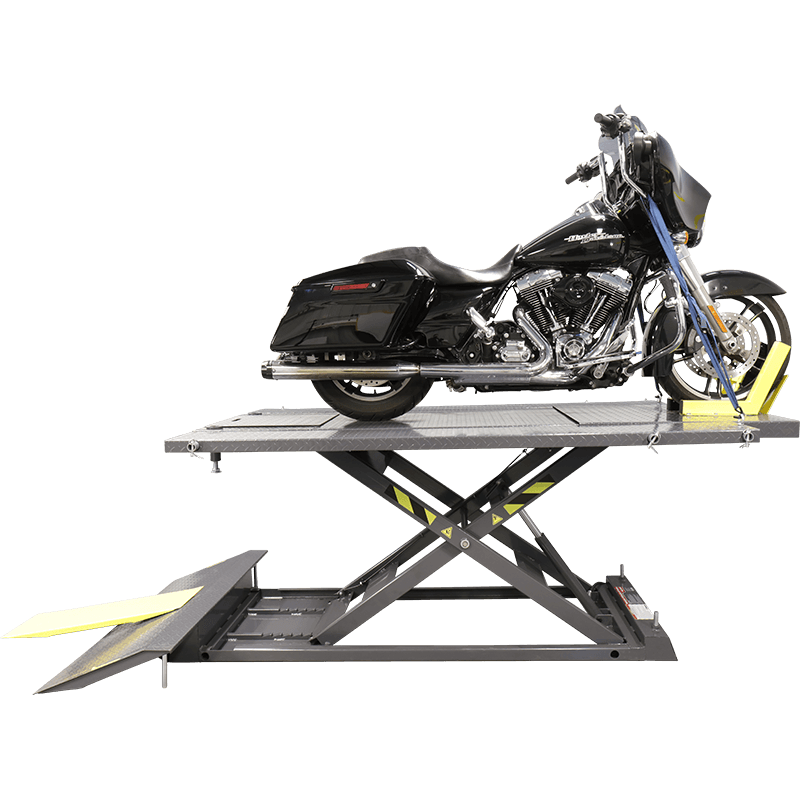
Features:
- 1,500 lbs. weight capacity
- 7.75″-45″ lift range
- 79.5″ platform length
- 99.75″ platform length with extension
- 29.5″ platform width
- 51″ overall width with side decks
- 134.75″ overall length with extension and ramp
- Air/hydraulic power supply
- Six lock positions for working height
- Retractable full-swivel casters with precision ball bearings
- Chrome-alloy front wheel vise with hardened crank handle
- 90-160 psi air supply requirement
- 808 lb. shipping weight
- 46″ × 91″ × 16″ shipping dimensions
- Ranger-backed warranty
Pros:
- Extended platform and 45″ max height give you full working access for large bikes and long frames
- Removable side decks and rear drop-out panel make wheel and suspension work much easier
- Retractable casters allow movement even when the lift is loaded
- Air/hydraulic power system offers smooth lifting with very little effort
Cons:
- Large footprint requires a dedicated space in the garage or shop
Learn more about the Ranger RML-1500XL.
- Black Widow Hydraulic Motorcycle Lift Table

The Black Widow hydraulic motorcycle lift table works via a hydraulic foot-pump. It raises motorcycles up to 32″ for maintenance, storage, and service without needing an air compressor. The platform includes a built-in wheel clamp and rear drop-out panel for loading and wheel access. It also has integrated dolly wheels, so the lift can be moved around the garage even when a bike is on it.
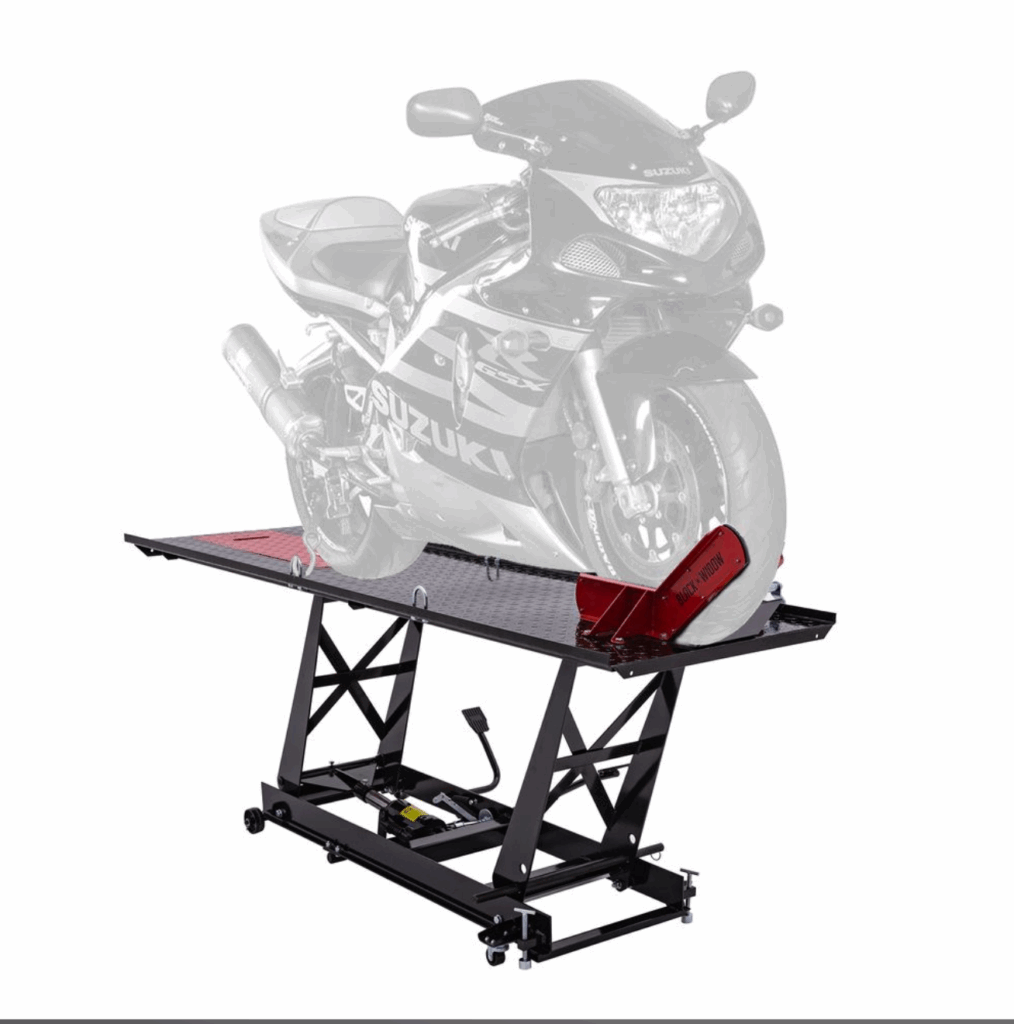
Features:
- 1,000 lbs. weight capacity
- 7-7/8″ to 32″ lift range, with a 21″ middle locking position
- 86-3/4″ × 26-7/8″ platform size with a diamond-plate surface
- 25-1/2″ ramp length
- Optional center jack compatibility
- 272 lb. product weight
Pros:
- Supports most standard motorcycles
- Allows for repositioning with dolly wheels
Cons:
- Limits usage for heavier bikes with the 1,000 lb. rating
- Feels tight for motorcycles with wide bars or extended accessories
- OTC 1545 Ultra Low Profile Motorcycle and ATV Lift

The OTC 1545 is a low-profile motorcycle and ATV lift. It uses a wide, alloy-steel frame with 17″ skids to support larger cruisers and wider powersports vehicles. The lift operates with a foot-pedal release and includes an automatic safety lock, rear locking casters, and two ratcheting tie-down straps.
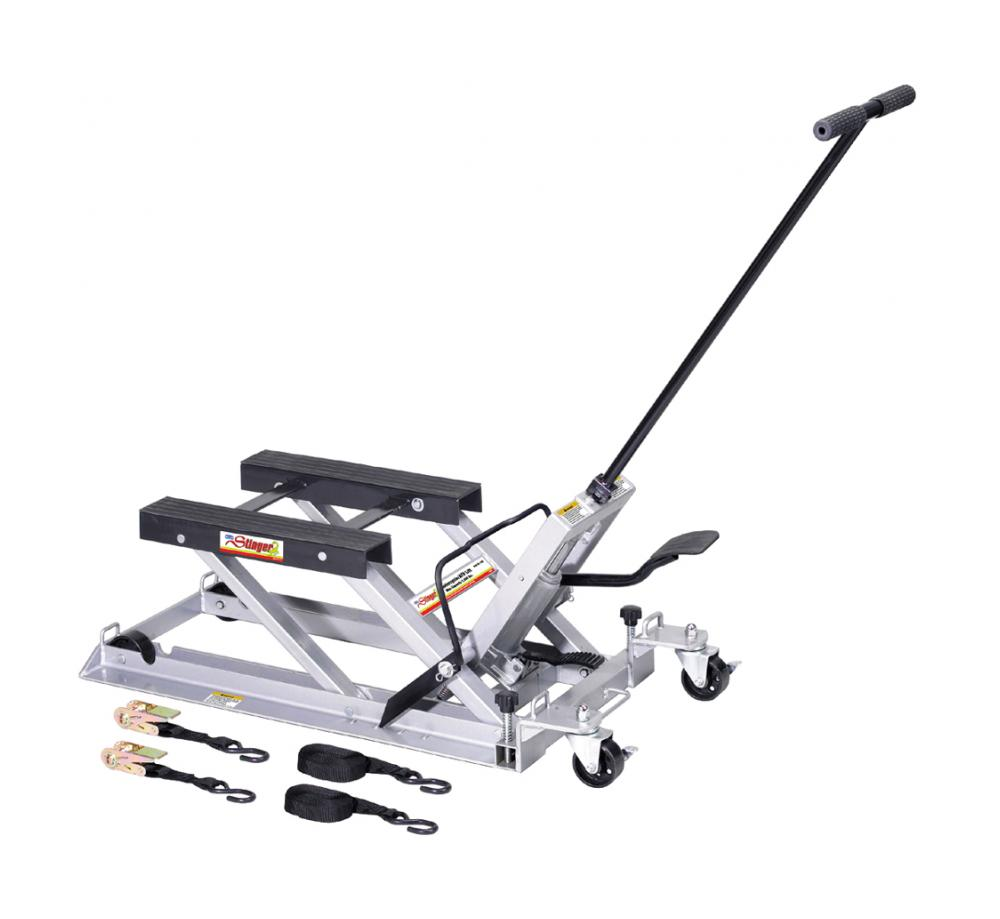
Features:
- 1,500 lbs. weight capacity
- 3.5″ to 16.75″ lift range
- 3.5″ minimum height
- 17″ skid length
- 90 lb. item weight
- 20″ × 6.5″ × 39.25″ dimensions
Pros:
- Low minimum height works for cruisers and low-slung motorcycles
- Removable T-handle improves maneuverability
Cons:
- Feels less stable for very large touring motorcycles
- Requires more strength to reposition without using the built-in casters
- VIVOHOME Steel Wide Deck Motorcycle Lift

The VIVOHOME steel wide deck motorcycle lift is a compact scissor-style motorcycle lift designed for center-frame lifting using a hand crank. It uses a steel frame with a powder-coated finish and a wide rubberized platform to prevent slipping and protect the bike’s frame. It’s compatible with cruisers, dirt bikes, ATVs, snowmobiles, and other powersports models.
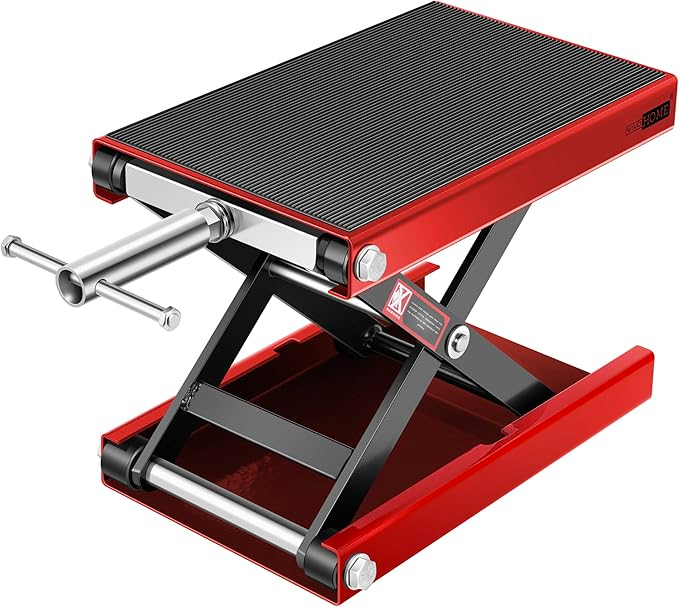
Features:
- Weight capacity: 1,100 lbs.
- Lift range: 3.5″ to 14.5″
- Platform size: 14.4″ L × 9″ W
- Item weight: 12.5 kg (approx. 27.5 lbs.)
- Dimensions: 14.4″ × 9″ × 3.5″
Pros:
- Wide rubberized platform provides good frame contact and reduces slipping
- Compact size stores easily in small garages or tool areas
Cons:
- Maximum lift height of 14.5″ limits the working room for certain repairs
- Manual crank requires more effort compared to hydraulic or foot-pump lifts.
- Orion Motor Tech Motorcycle Lift
The Orion Motor Tech motorcycle lift is a steel scissor-style lift designed for center-frame lifting on motorcycles with a flat underside or added support plate. It operates using an included T-handle or a 3/8″ socket and ratchet for cranking. The lift uses a wide rubberized deck to keep the bike steady during raising and lowering.
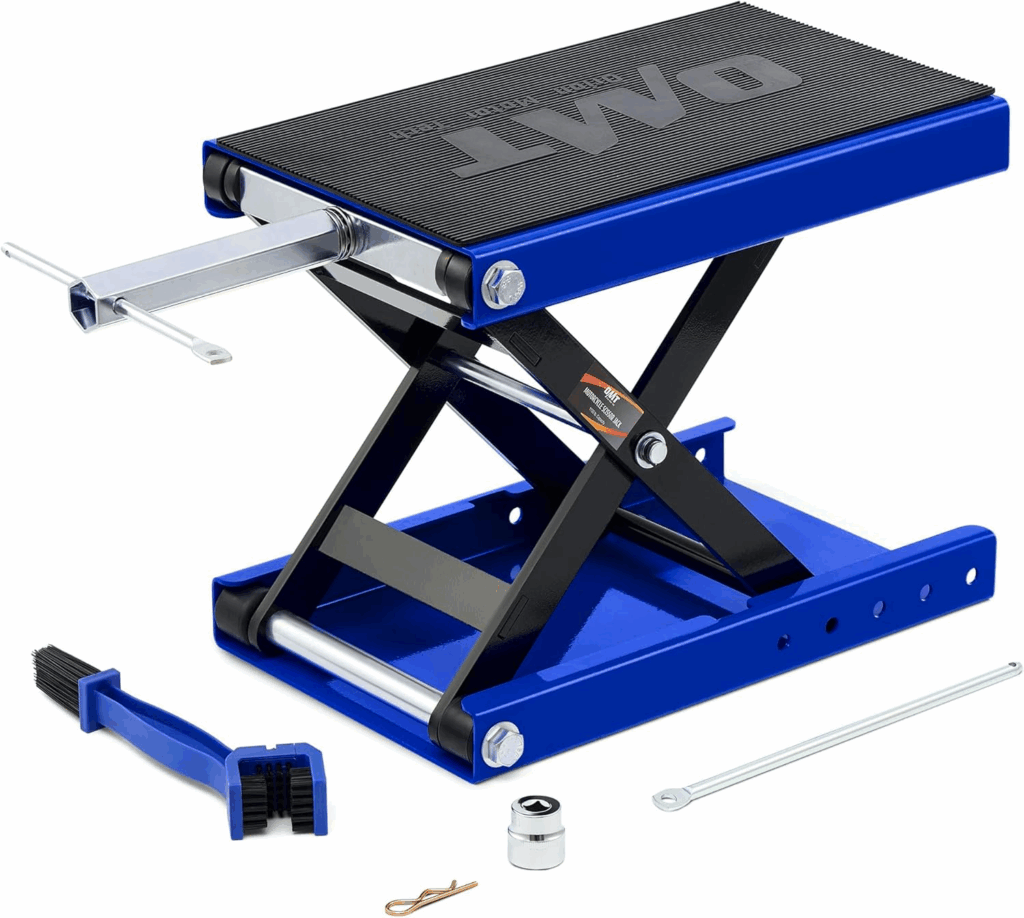
Features:
- Weight capacity: 1,100 lbs.
- Lift range: 3.7″ to 14.6″
- Deck size: 9.1″ × 14.6″
- Item dimensions: 17.32″ L × 10.24″ W × 4.33″ H
- Maximum deck compatibility: Requires flat contact surface at least 9″ wide
Pros:
- Provides support during lifting and lowering
- Improves stability under load with double crossbars
Cons:
- Offers limited working room for taller bikes
- Only works with motorcycles that have a flat underside or added support plate.
- Torin Big Red T64017 Hydraulic Powersports Lift Jack

The Torin Big Red T64017 is a hydraulic powersports lift made for motorcycles, ATVs, UTVs, and snowmobiles. It uses a built-in bottle jack for lifting and includes a pulling bar and swivel casters for positioning the platform. It offers six locking positions for height adjustments.
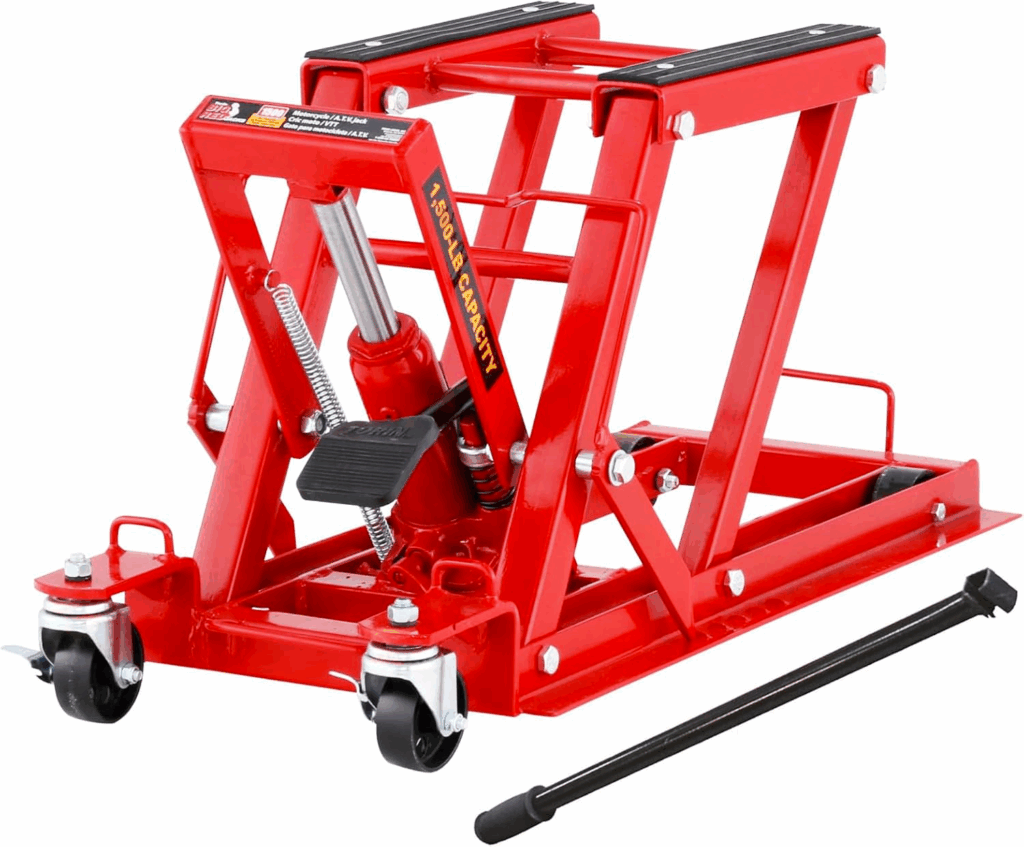
Features:
- 1,500 lbs. weight capacity
- 5-1/8″ to 16-1/8″ lift range
- 16.13″ maximum lift height
- 36.6″ × 17.5″ × 5.2″ item dimensions
Pros:
- Supports heavier powersports vehicles
- Offers controlled height adjustments.
Cons:
- Limits access for repairs that need more working room
- Requires more garage space than compact scissor jacks
- CXRCY 1200 LBS Motorcycle Lift Scissor Jack

The CXRCY 1200 lbs. motorcycle lift scissor jack can lift motorcycles, ATVs, UTVs, and snowmobiles. It uses a hand crank or an included ratchet wrench for lifting and features an upgraded bearing system. The deck has a thickened rubber pad to improve grip and protect the frame from scratches.
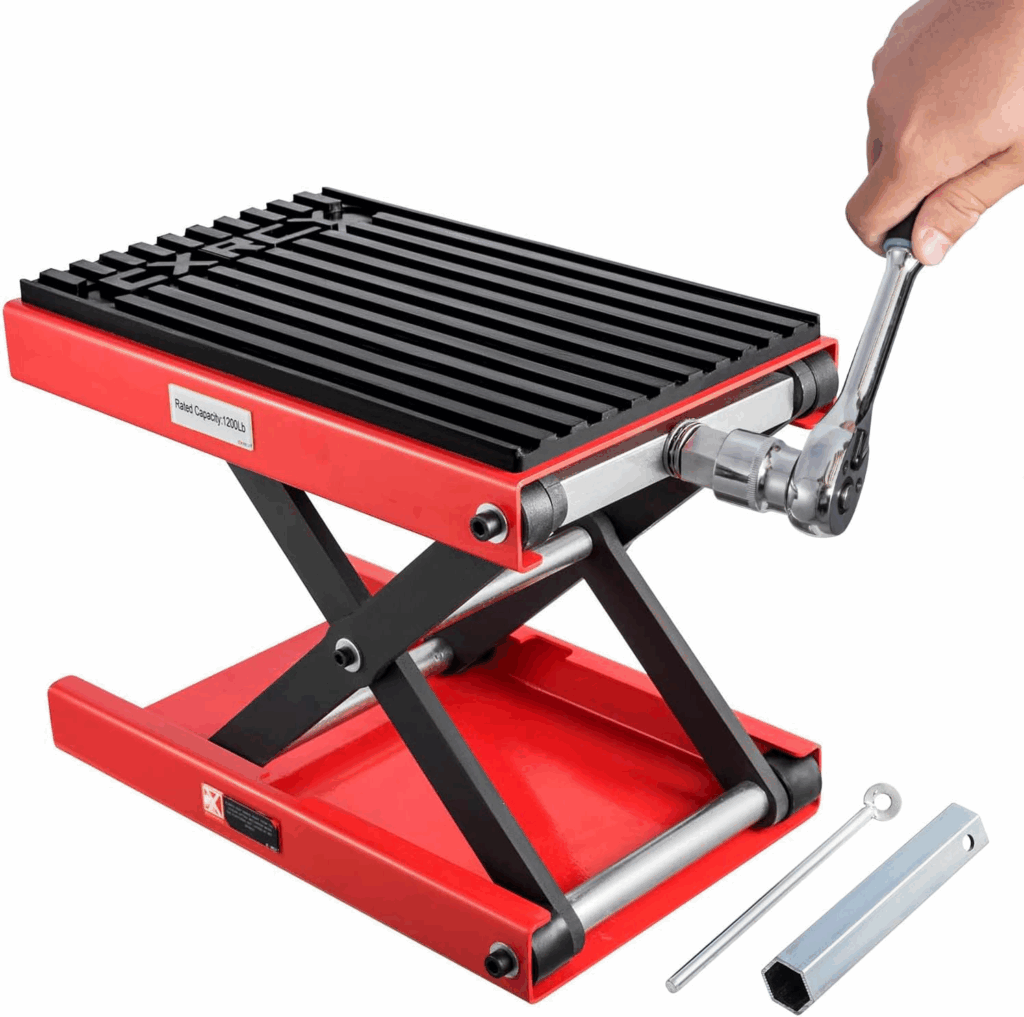
Features:
- 1,200 lbs. weight capacity
- 4.13″ to 14.96″ lift range
- 14.6″ × 9.2″ platform size
- 14.6″ L × 9.2″ W × 4.1″ H dimensions
Pros:
- Ratchet wrench option reduces effort during lifting
- Thick rubber pad offers grip and frame protection
Cons:
- Limits access for taller repair work
- Requires a flat frame contact area for proper lifting
How to choose the best motorcycle lift
Choosing the right type of lift is one of the biggest factors in how safely and efficiently you can work. The lift you pick affects stability, working height, and how confidently you can move around the bike once it’s in the air. As you research your options, consider:
- Weight capacity: Start by looking up your motorcycle’s official weight with gas and oil included. Your lift should comfortably support that weight, plus a margin for heavier add-ons or any larger bikes you might work on later. A lift that’s rated for a slightly heavier weight will feel more stable when you remove wheels or shift the bike’s center of gravity during a repair.
- Lift range: Check both the minimum and maximum height and match them to the bikes you’ll be working on most. Taller cruisers and ADV bikes may need more lift height, while low-slung sportbikes or customs can be harder to load if the platform starts too high. Also, think about your workspace. Garages with low ceilings or tight corners can limit how high you can comfortably raise the bike.
- Portability: Consider how often the lift needs to move. If you’re working in a small garage, wheels or a folding frame can make storage easier after a job. If you run a shop or have a dedicated work area, a heavier, stationary lift may give you more stability and room to work without worrying about rolling it out of the way.
- Platform size: Make sure the platform or deck is wide enough to support your bike’s frame points without forcing the weight onto a narrow contact area. Wider platforms feel noticeably steadier when you’re removing wheels, adjusting suspension, or leaning over the bike. If you switch between multiple bikes, pick a size that fits the biggest one you plan to lift so you’re not limited later.
- Build quality: Look for solid steel construction, smooth welds, and a lifting mechanism that feels controlled rather than jumpy. Better-built lifts hold their stability when the bike’s weight shifts, like the moment you take off a wheel. A lift that’s well-made will also require less maintenance over time, which means fewer adjustments and more reliable support every time you roll a bike onto it.
Benefits of using a motorcycle lift
With a motorcycle lift, instead of adjusting yourself to the bike, the bike adjusts to you. This makes longer jobs safer overall and easier on your body. You’ll also notice better:
- Accessibility: A lift puts the bike at a comfortable working height so you’re not bending, crouching, or twisting to reach parts. It makes things like brake service, chain cleaning, and engine access feel more natural because everything is in your line of sight. This is especially helpful during detailed work where you need full visibility without repositioning the bike.
- Safety: A proper lift keeps the bike stable from the moment you load it, even when you’re removing wheels or shifting weight from one side to the other. You’re less likely to deal with sudden movement or an unexpected lean, which reduces the risk of the bike tipping during a repair. Having a steady platform also lets you focus on the job instead of worrying about balance.
- Repair efficiency: With the bike elevated, tools reach where they need to go without awkward angles or limited space. You can roll a stool or tool cart right next to the platform and move around the bike without constant repositioning. The extra working room speeds up everything, especially if you maintain your bike regularly.
Find the best motorcycle lift to fulfill your needs with Wrenchers
Now that you know what really matters in a motorcycle lift, you can pick one that fits your bike and the way you like to work. The right lift makes regular maintenance easier to reach, safer to handle, and a lot less tiring on your back.
If you’re not sure which style fits your setup, contact Wrenchers so you can find the one that makes the most sense for your bike and your space. Once you have a stable, well-fitted lift, everything from wheel service to routine cleaning feels more controlled and less of a strain.
Shop motorcycle lifts at Wrenchers.
Best Motorcycle Lifts FAQs
What are the different types of motorcycle lifts?
The most common types of motorcycle lifts you’ll find are scissor lifts, hydraulic tables, and low-profile jack-style lifts. Scissor lifts are compact and raise the bike from the frame, while hydraulic tables give you a full platform for bigger jobs and long-term storage. Low-profile jacks work well for quick maintenance or tight garage spaces where a full table doesn’t fit.
What kind of maintenance is required for a motorcycle lift?
Most lifts only need occasional checks to stay in good shape, like keeping the lifting surfaces clean, tightening any bolts that loosen over time, and checking for smooth movement in the lifting mechanism.
Hydraulic lifts may need fluid top-offs over time. It’s also smart to inspect the rubber pads or frame contact points so the bike stays steady every time you load it.
Are motorcycle lifts safe to use at home?
Yes, as long as you choose a lift that matches your bike’s weight and use it on a flat, solid surface. Safety locks, tie-down points, and stable contact areas all make home use much safer than balancing a bike on improvised supports. Just take a moment to center the bike properly before lifting. Small adjustments at the start make the entire job more secure.
