
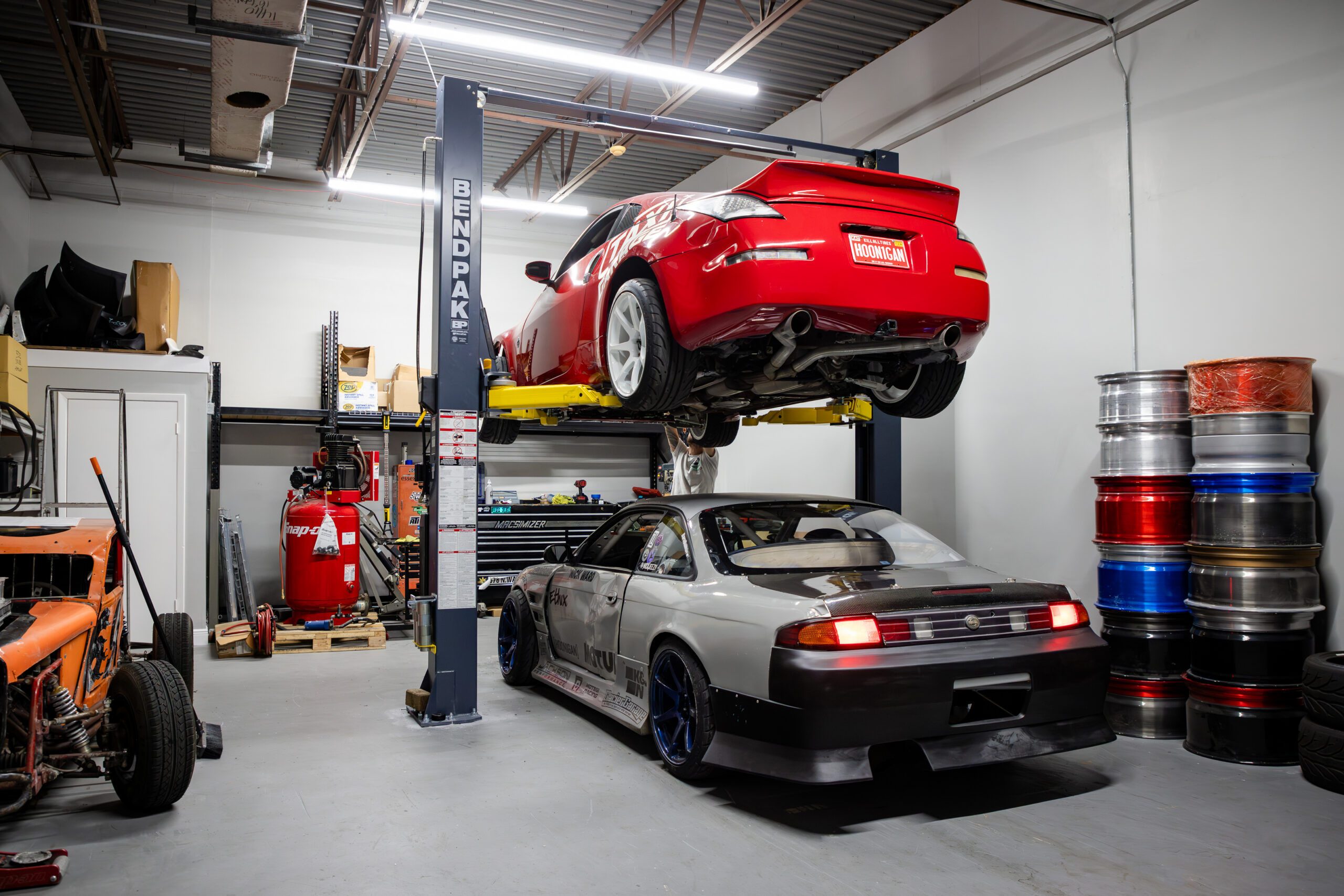
The U.S. Bureau of Labor Statistics counts 825,800 automotive service technician jobs in 2025 and projects 5 percent growth through 2035. That’s a lot of people working under car lifts, and BendPak vs. Rotary is one of the first matchups buyers run into when they pick one.
Both brands build two-post, four-post, and heavy-duty lifts, but they price, build, and back those lifts differently. Install requirements, warranty terms, and ceiling height can matter as much as the lift itself.
This guide compares the two brands on price, build quality, safety, warranty, and installation, for DIYers sizing up a home garage and shop owners outfitting service bays. Quick disclosure: we’re a BendPak dealer, and we don’t sell Rotary, which is sold through its own distributor network
Key Takeaways
- BendPak generally costs less: the 10AP lists at $6,095 at Wrenchers, while dealer listings for the comparable Rotary SPOA10-AV run about $8,450 to $8,800.
- BendPak’s standard warranty covers cylinders and the power unit for two years no matter who installs the lift, while Rotary’s second functional year requires an authorized installer.
- The BendPak 10AP adds ASARS automatic arm restraints and loads vehicles symmetrically or asymmetrically with one set of arms, while Rotary splits those jobs between the SPOA10-AV and SPO10.
BendPak vs Rotary at a glance
BendPak generally costs less and fits budget-minded home garages and shops. Rotary carries a premium, and its lifts are built in Madison, Indiana, and sold through authorized distributors and installers. We pulled every detail below from BendPak’s and Rotary’s own product pages, manuals, and warranty documents, plus our Wrenchers product listings.
Not sure which column fits your bay? Talk to our lift specialists and we’ll help you size it up.
BendPak Lift Overview
BendPak is the value pick in this matchup, with a broad lineup for home garages and commercial bays alike. Its catalog lists two-post, four-post, alignment, scissor, parking, mobile column, and portable lifts, plus EV battery lift tables. You can see what we carry on our BendPak brand page.
The BendPak 10AP shows where the brand fits best. Its Bi-Metric arms let you load a vehicle symmetrically or asymmetrically without changing out arms. That’s handy when one bay handles a pickup on Monday and a compact on Tuesday.
Need more height for tall vans and trucks? The 10APX high-rise is BendPak’s high-rise take on the 10AP. Our full two-post lift lineup covers more BendPak options and other brands.
For storage and long wheelbases, our four-post lifts let you drive on and park. Fleets and heavy-truck shops can step up to the HDS-27X four-post lift, rated at 27,000 lb. Mobile column lifts round out the heavy-duty options.
BendPak also suits buyers who plan to install the lift themselves. Its standard two-post and four-post warranty doesn’t tie hydraulic coverage to an authorized installer. When you need help, BendPak’s service locator points you to the nearest authorized service center.
Our product specialists can check your ceiling and slab before you order. Contact us to get a quote on the right BendPak lift.
Rotary Lift Overview
Rotary sells its car and truck lifts through authorized distributors and installers, and it prices them by quote. We don’t carry Rotary, so a local Rotary distributor is your route if you choose that brand.
Rotary’s car lift lineup covers two-post, four-post, in-ground, scissor, low-rise, and mid-rise lifts. It also offers mobile-column truck lifts and motorcycle lifts. In-ground lifts stand out, since BendPak doesn’t list that category in its own lineup.
On two-post lifts, Rotary’s asymmetric models run 7,000 to 10,000 lb, and symmetric models run 10,000 to 18,000 lb. The SPOA10-AV is its 10,000-lb asymmetric lift. Rotary rotates the columns 30 degrees and pairs shorter front arms with longer rear arms.
That geometry shifts the vehicle’s center of gravity behind the lift structure, according to Rotary. Shops that prefer a dedicated symmetric setup can look at the SPO10 instead. Comparing like with like matters here, since the BendPak 10AP handles both loading styles with one set of arms.
Rotary builds its two-post columns, arms, and carriages in Madison, Indiana. The company says this helps it deliver steadier pricing and lead times. Lifts ship straight from that plant.
Installation is where Rotary leans hardest on its network. Its authorized installer locator helps you find a certified crew near you. That matters because Rotary’s longer functional warranty depends on an authorized install, which we cover below.
Rotary is a solid fit for commercial bays that want one local partner for sales, installation, and service. Home-garage buyers planning a DIY install should weigh the warranty terms before they commit.
BendPak vs. Rotary: How the Lifts Compare
BendPak usually wins on price and standard parts coverage, while Rotary’s higher price comes with US-built hardware and an installer-backed service model. Here’s how that plays out across four areas.
Price and value
BendPak generally costs less, and Rotary carries a premium. At last check on October 20, 2026, we list the BendPak 10AP two-post lift at $6,095.
Rotary doesn’t publish prices, so dealer listings are the best guide. As of October 2026, dealer listings for the SPOA10-AV run about $8,450 to $8,800. Those figures put the gap at roughly $2,350 to $2,700 before freight and installation.
So what do you get for the higher price? Rotary’s columns, arms, and carriages are built in Madison, Indiana, and you get access to its authorized installer network. With an authorized install and registration, you also get a second year of functional warranty.
BendPak’s lower price still gets you a capable 10,000-lb lift with Bi-Metric arms and an automatic arm restraint system. For tighter budgets, our two-post lifts typically run about $2,500 to $6,000, and floor-plate models run around $10,000. Prices change and vary by dealer, so confirm the current figure before you order.
Build quality and engineering
Both brands use proven but different engineering approaches, so the right pick depends on how you load vehicles. Here’s what each one documents.
The BendPak 10AP uses oversized 53-inch and 59-inch carriages and dual hydraulic direct-drive cylinders. Self-lubricating UHMW polyethylene bearings guide the carriages, and four triple-telescoping arms handle the reach. BendPak’s manual says the 10AP is designed and engineered in Southern California and made in China.
The Rotary SPOA10-AV uses Rotary’s Double “S” multi-bend column design. It lists a 3-3/8-inch minimum adapter height and 58-1/4 inches of arm extension. An optional Shockwave 110-volt DC power system lifts twice as fast, according to Rotary.
We couldn’t find published column steel specs for the 10AP, so we aren’t comparing steel thickness here. If that matters to you, ask each manufacturer directly.
Safety systems and certification
Both brands make ALI-certified models, and certification is checked one model at a time. ANSI/ALI ALCTV is the North American safety standard for lift design, construction, and performance.
The catch is that ALI certifies individual lift models, not manufacturers. BendPak notes that not all of its models are ALI certified. Rotary says its two-post lifts are tested and certified by ALI and ETL, and the exact model is still worth checking in the ALI directory.
Arm restraints keep the lift arms from swinging out of position once a vehicle is up. BendPak uses its Automatic Swing Arm Restraint System (ASARS), a forged-steel design with a full 360-degree grip. BendPak says the restraints withstand more than 2,000 pounds of side force.
The 10AP also has safety locks spaced every 3 inches in each column, with a single-point safety release. On the Rotary side, authorized distributor Derek Weaver lists the SPOA10-AV’s swing arm restraints as locking automatically above 2-1/2 inches. It also lists an automatic hydraulic safety system that works in all positions.
Whichever brand you choose, plan for upkeep. ALI states that every lift installed in the US and Canada must be inspected at least annually.
Warranty and support
BendPak gives longer standard parts coverage, while Rotary rewards buyers who use its authorized installers. Read the fine print for the exact model you’re buying.
BendPak’s limited warranty covers standard two-post and four-post lift structures for five years. Hydraulic cylinders and the power unit get two years, and operating and electrical components get one year. Labor is covered for one year, and high-rise and specialty lifts fall outside these terms.
Rotary’s warranty on surface lifts up to 30,000 lb is five years structural, one year functional, and one year labor. The second year of functional parts coverage requires registration and installation by a Rotary authorized installer. Warranty remedies also go through an authorized installer.
Credit where it’s due: Rotary’s installer network gives shops a clear path for installation and repairs. BendPak earns its credit on structural and hydraulic coverage that doesn’t hinge on who bolts the lift down.
For long-term cost, DIY installers get more from BendPak’s terms. Shops that pay for professional installation anyway can capture Rotary’s second year. Either way, budget for freight, installation, and annual inspections.
How to choose: home garage vs commercial shop
Home garages usually come down to ceiling height and budget, which favors BendPak and portable lifts. Commercial shops can justify either brand. Check your space first, then match the brand to how you work.
Check your space before you pick a brand
- The 10AP stands 145 inches tall with 1 inch of clearance required, so plan on roughly 12 feet 2 inches.
- Rotary lists a 12-foot minimum for the SPOA10-AV, or 12 feet 6 inches with Shockwave power.
- The 10AP needs 4.25-inch, 3,000 psi concrete cured 28 days. For Rotary, check the model’s installation manual.
- Both 10,000-lb lifts suit cars and light trucks. Heavier rigs point toward the 27,000-lb HDS-27X or Rotary’s symmetric two-post lifts.
Working under an 8- or 9-foot ceiling? You still have mid-rise scissor, low-clearance two-post, and portable two-post options.
Pick BendPak if
- You’re a DIYer with a lower ceiling. Start with our home garage lifts.
- You need to store the lift between jobs. Look at QuickJack portable lifts or our portable car lifts.
- You want a portable two-post setup for a home garage. Check out MaxJax.
- You have about 12 feet of clearance and want a full-rise lift. Browse our two-post lifts.
- You run fleet or heavy-truck bays. Compare the HDS-27X with our mobile column lifts.
Pick Rotary if
- You run a commercial shop and want one local partner for installation and service. Use Rotary’s installer locator.
- You need an in-ground lift, a category Rotary offers and BendPak doesn’t list.
- You want columns built in Madison, Indiana and can absorb the price premium.
- You want a BendPak quote to compare first. Contact us and we’ll price a matching lift.
BendPak vs. Rotary: Find the Right Lift for the Job
BendPak vs. Rotary comes down to budget, space, and how you plan to install. Here’s the short version.
- BendPak generally costs less. The 10AP lists at $6,095 at last check, and comparable Rotary models cost more at dealers.
- Both brands offer ALI-certified lifts, and certification is per model. Check the exact model in the ALI directory.
- BendPak’s standard warranty suits DIY installers, while Rotary’s best coverage requires an authorized installer.
- Measure first. Rotary lists a 12-foot minimum ceiling for the SPOA10-AV, and the BendPak 10AP stands 145 inches tall plus 1 inch of clearance.
We’re a BendPak dealer, and we’ll tell you straight if a portable lift or four-post fits your space better. Contact our lift specialists for a quote, a spec check, or help picking the right lift.
BendPak vs. Rotary FAQs
Is BendPak better than Rotary?
Neither brand is better across the board, because each one fits a different buyer. BendPak’s 10AP Bi-Metric arms load vehicles symmetrically or asymmetrically, while Rotary splits those jobs between the SPOA10-AV and SPO10. Origin differs too: the 10AP is designed in California and made in China, and Rotary builds its two-post columns in Madison, Indiana.
Will a BendPak or Rotary two-post lift fit a standard home garage?
A full-rise 10,000-lb two-post fits only if your garage has the height, floor space, and slab to match. Rotary lists a 12 x 24-foot minimum bay for the SPOA10-AV. BendPak warns installers never to drill into a post-tension concrete foundation, so confirm your slab type first. If your garage falls short, our home garage lifts include options built for tighter spaces.
Why are Rotary lifts so expensive?
Rotary doesn’t publish a reason, but its higher price comes with US-built hardware, an installer-backed sales model, and quote-based pricing that often excludes freight and install. The company builds columns, arms, and carriages in Madison, Indiana, and it sells through quotes rather than posted prices. Because freight and installation are often extra, budget for both when you compare quotes. Rotary’s extra year of functional coverage comes with an authorized install and registration.
